
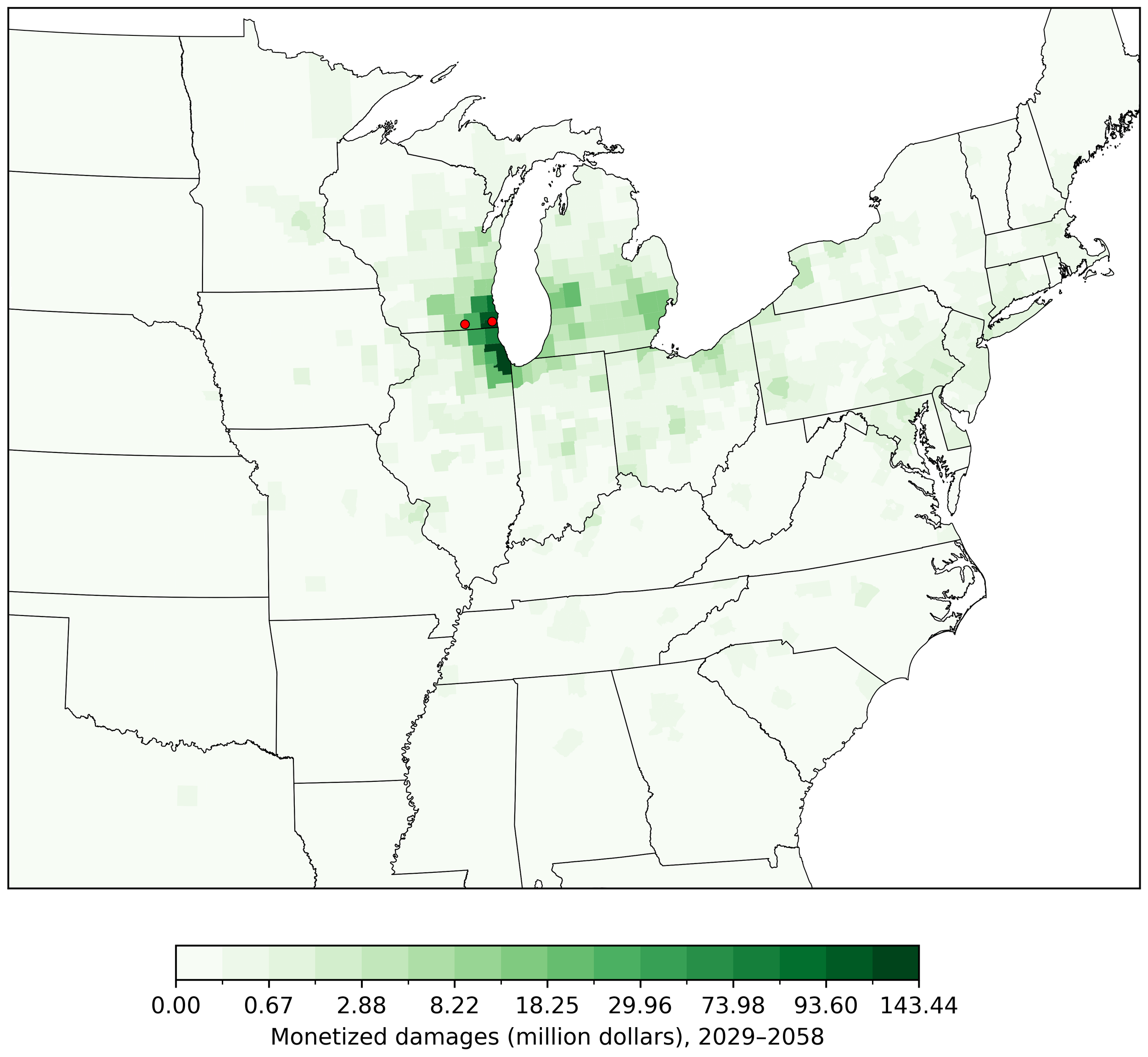
Monetized health harms from air pollution from Foundry Ridge and Red Oak Ridge (red circles) by county over their 30-year lifetimes
Air Quality and Health Effects of the Foundry Ridge and Red Oak Ridge Energy Centers
by Nicholas Mailloux, Mokshda Kaul, Morgan Edwards, Jonathan Patz
Energy infrastructure developers across the United States are proposing to construct new natural gas–fired power plants to meet projections of rising electricity demand caused in part by the proliferation of data centers. Two new natural gas–fired power plants are proposed for construction in southeastern Wisconsin: the Foundry Ridge Energy Center in Walworth County and the Red Oak Ridge Energy Center in Kenosha County.
Researchers at the University of Wisconsin–Madison quantified the potential air quality and health effects resulting from the operation of these two plants using information in publicly available applications to the Public Service Commission of Wisconsin and the Wisconsin Department of Natural Resources.
The analysis finds that:
At 1,186 megawatts, Red Oak Ridge would be the second largest of the 29 existing natural gas–fired power plants in Wisconsin by electricity generation capacity. Foundry Ridge would be the twelfth largest at 324 megawatts.
Combined annual emissions of fine particulate matter (PM2.5), sulfur dioxide (SO2), nitrogen oxides (NOx), and volatile organic compounds (VOCs) from Foundry Ridge and Red Oak Ridge would equal or exceed emissions from all fuel combustion from commercial and institutional sources in Kenosha County and Walworth County.
Air pollutant emissions from Foundry Ridge and Red Oak Ridge would lead to elevated fine particulate matter (PM2.5) exposure across the Upper Midwest and broader eastern United States, with the largest effects in downwind areas in southeastern Wisconsin, western Michigan, and the Chicago region.
PM2.5 exposure from the facilities could cause 4 excess premature deaths in their first year of operation and a cumulative total of 118 excess premature deaths over their 30-year lifetimes.
PM2.5-related health harms equate to $44.4 million in air quality damages across the United States in their first year of operation. Over their 30-year lifetimes, cumulative air quality damages from the facilities could total $1.38 billion nationwide, with $486 million (35%) in damages occurring in Wisconsin.